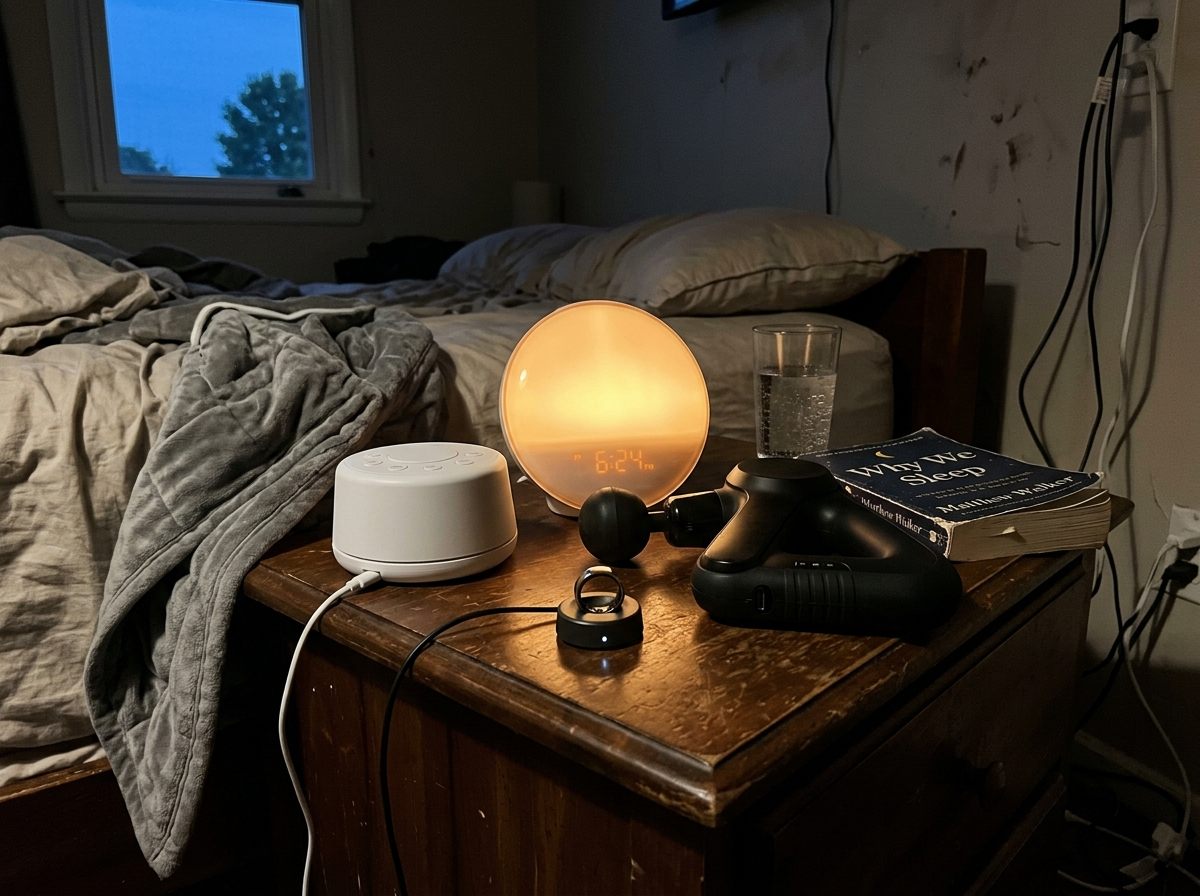
A few months ago, after a particularly rough stretch of groggy mornings and sore backs, two of us on the Consumer Finds team made an informal pact: we'd spend our own money on five of the most-talked-about sleep and recovery gadgets, actually live with them for six to eight weeks each, and report back with no agenda other than honesty. No brands sent us anything. No one was compensated to write nice things.
The short version: two of the five gadgets genuinely changed something for us, one was polarizing along predictable lines, one was useful but narrower than advertised, and one made us feel worse — not because it was broken, but because we started treating data as a problem to solve at 6 a.m. More on that last one in a minute.
Here's what we found, in the order we tried them.
1. The white-noise machine
We picked up a compact white-noise machine about the size of a hockey puck — the kind you plug into a wall outlet and control with a single dial. It offered a handful of sound profiles: white noise, pink noise, brown noise, and a few nature loops. We set it to brown noise and forgot about it for the first week, half-expecting to stop noticing it.
We didn't stop noticing it, but not because it was annoying. We noticed it because on the nights one of us forgot to turn it on, falling asleep felt harder and the usual apartment sounds — a neighbor's TV, a truck on the street below — felt more intrusive by comparison. That comparison became the real data point.
"I didn't realize how much ambient noise I was filtering out every night until I had something to mask it. Now if I travel and forget to bring the machine, I end up running a YouTube brown-noise video on my phone instead. That felt like proof enough."
We both kept ours. At roughly $30–$50 for a basic unit, it's the cheapest thing we tested and the one we'd recommend without hesitation to almost anyone who doesn't already sleep in a genuinely quiet room. The main caveat is that the cheaper units have fans inside that can develop a subtle rattle after a few months. Pay the extra ten dollars for a solid-state model.
2. The sunrise alarm clock
This was the one we were most skeptical about and the one that surprised us most. A sunrise alarm clock sits on the nightstand and, in the 30 minutes before your set wake time, gradually brightens from deep amber to full daylight-equivalent white. The idea is that your body responds to the light shift before the alarm actually sounds, so you're not yanked out of deep sleep by a noise.
Skepticism: we both assumed this was the kind of thing that works great in a marketing video and does nothing in a real bedroom where the clock's glow is competing with curtains, a phone charger LED, and a smoke detector blinking in the corner.
Reality: one of us (the lighter sleeper, notably) found the gradual light shift genuinely changed how they woke up over the first two weeks. The alarm itself — a gentle chime set at maximum brightness — felt like an afterthought because by the time it went off, they were already close to awake. Mornings felt less jarring, and in their own subjective experience they felt less groggy for the first hour of the day.
The other tester, who sleeps with an eye mask most of the year, felt exactly zero effect. Which is obvious in retrospect — light doesn't penetrate fabric — but worth flagging: the sunrise clock only works if your face is actually exposed to the light. If you're a mask sleeper, skip this one.
3. The weighted blanket
The weighted blanket might be the most polarizing thing we've ever tested. We picked up a 15-pound option (roughly 10% of body weight, which is the commonly cited rule of thumb) in a cotton cover, and asked four people in our small circle to try it over a three-week period.
Results were almost perfectly split:
- Two people loved it immediately. One described it as feeling like "being gently held in place," which sounds odd but made sense when they explained it — they tend to move around a lot at night and found the weight grounding. They both reported falling asleep more quickly in their subjective experience during the test weeks.
- One person found it tolerable in winter but returned it when temperatures crept above 60°F. Even a lightweight cotton cover traps heat, and by the third week they were kicking the blanket off by 2 a.m. consistently.
- One person actively disliked it from night one. Found the weight claustrophobic rather than calming. Gave up after four nights. No shame in that — proprioceptive preferences are real and individual.
If we had to guess who benefits most: people who run cold, people who feel restless or fidgety at night, and people who enjoy the feeling of compression in general (think: people who like tight socks, or who hug a pillow). If you run hot or feel anxious in confined spaces, save your money.
One practical note: the cotton covers that most weighted blankets come with are genuinely annoying to wash. They're heavy, they take forever to dry, and the inner weighted insert usually can't go in the washing machine at all. Factor that into your decision if laundry logistics matter to you.
4. The percussive massage gun
We want to be clear about something up front: we are not athletes. We are two moderately active people in our thirties who occasionally go for runs and reliably wake up sore after a long day of sitting badly. We tested the massage gun from that context, not from a performance-recovery context, and our findings reflect that.
The gun itself — a mid-range model with four attachment heads and five speed settings — is genuinely useful for one specific thing: breaking up the kind of muscle tightness that builds up in your shoulders and upper back after too many hours at a desk. On that front, it worked well. Five minutes on the upper traps before bed, and the physical tension was noticeably reduced. We'd use it a few times a week and it earned its counter space.
Where we'd push back on the broader hype:
- For general soreness after a run, a foam roller accomplished roughly the same thing for a fraction of the price.
- The noise. At the higher speed settings, a percussive massage gun sounds like a power drill. Using it at 11 p.m. requires either a patient partner or headphones for everyone in the room.
- The attachments feel meaningful in marketing copy and mostly interchangeable in practice. We defaulted to the round ball head every single time.
Our honest verdict: genuinely useful if you carry chronic tension in specific spots and you'll actually use it consistently. Less useful as a general "recovery" tool for the average non-athlete. If you're on the fence, try a foam roller first — it's $20 and accomplishes more than people expect.
5. The sleep-tracking ring
This is where we have to be most careful, because the product itself is well-made and the data it surfaces is genuinely interesting. The ring — a smooth titanium band worn on the index finger — tracks resting heart rate, heart-rate variability, skin temperature, movement, and blood oxygen through the night, and presents all of it in a companion app as a sleep score and a readiness score each morning.
We wore it for seven weeks. Here is what actually happened:
For the first two weeks, it was fascinating. We cross-referenced the data with how we actually felt and found reasonable correlations — nights with poor scores often did line up with mornings we remembered as rough. That was validating.
By week three, something shifted. One of us started making small adjustments based on the scores — going to bed earlier, skipping a late coffee, cutting out evening screen time. Some of this was probably net positive. But a new behavior crept in alongside it: checking the score before fully waking up, and letting a low readiness number set the tone for the morning before anything had actually happened.
"I caught myself telling my partner I was going to have a bad day before I'd gotten out of bed. I was pre-exhausted based on a number. That felt like the wrong direction."
The other tester had a different experience — they found the trends useful over multi-week windows and were less reactive to individual nightly scores. This probably matters: if you're a person who can use data as a loose reference rather than a directive, the ring may be genuinely useful. If you have any tendency toward health anxiety, or if you're already a light sleeper who lies awake overthinking sleep quality, a sleep tracker may add friction rather than remove it.
We returned the ring after the test period. That's not a knock on the hardware — it's well-engineered and the app is clean. It's a knock on us, specifically, for not being the right kind of user for it.
What we'd buy again
If we had to start fresh:
- White-noise machine: Yes, immediately, no hesitation. The lowest cost, the highest-consistency return, the easiest habit to build.
- Sunrise alarm clock: Yes — with the caveat that you don't sleep with a mask and your bedroom can get reasonably dark at night. Otherwise it's a fancy clock.
- Weighted blanket: Maybe. We'd try before buying if possible, or order from somewhere with a real return window. It's a body-chemistry question more than a product-quality question.
- Percussive massage gun: Only if you have a specific use case for it — desk worker with chronic shoulder tightness, someone who runs regularly. Otherwise a foam roller is 90% of the benefit.
- Sleep-tracking ring: Not for us, though we'd suggest trying a lower-commitment version first (many smartwatches offer basic sleep tracking) to see how you respond to the data before investing in a dedicated device.
A note on all of this
One broader thing this exercise reinforced: the category "sleep gadget" is doing a lot of work. Some of these products are really environmental tools — they change the conditions around you (sound, light, compression) in ways that may or may not suit your specific situation. Others are data tools that surface information about something that was already happening. Those are fundamentally different value propositions, and it's worth being honest with yourself about which type you're actually looking for before spending money. Environmental tools tend to be cheaper and more universally applicable. Data tools require a specific kind of personality to get value from — curious, non-anxious, comfortable treating numbers as loose signals rather than verdicts.
We want to be explicit: nothing in this article is medical advice, and we're not in a position to make health claims about any of these products. Everything we've described is our own subjective experience over a limited testing period with a small group. If you're dealing with persistent sleep difficulties, chronic pain, or anything that meaningfully affects your health, please talk to a doctor — not a review blog.
What we can say honestly is that the right low-cost habit change — in our case, consistent brown noise and a gentler alarm — was worth more in practice than the most expensive gadget we tried. That's probably not a surprise to anyone who has spent time in this category before. But it was a useful reminder for us, and maybe it's useful for you too.