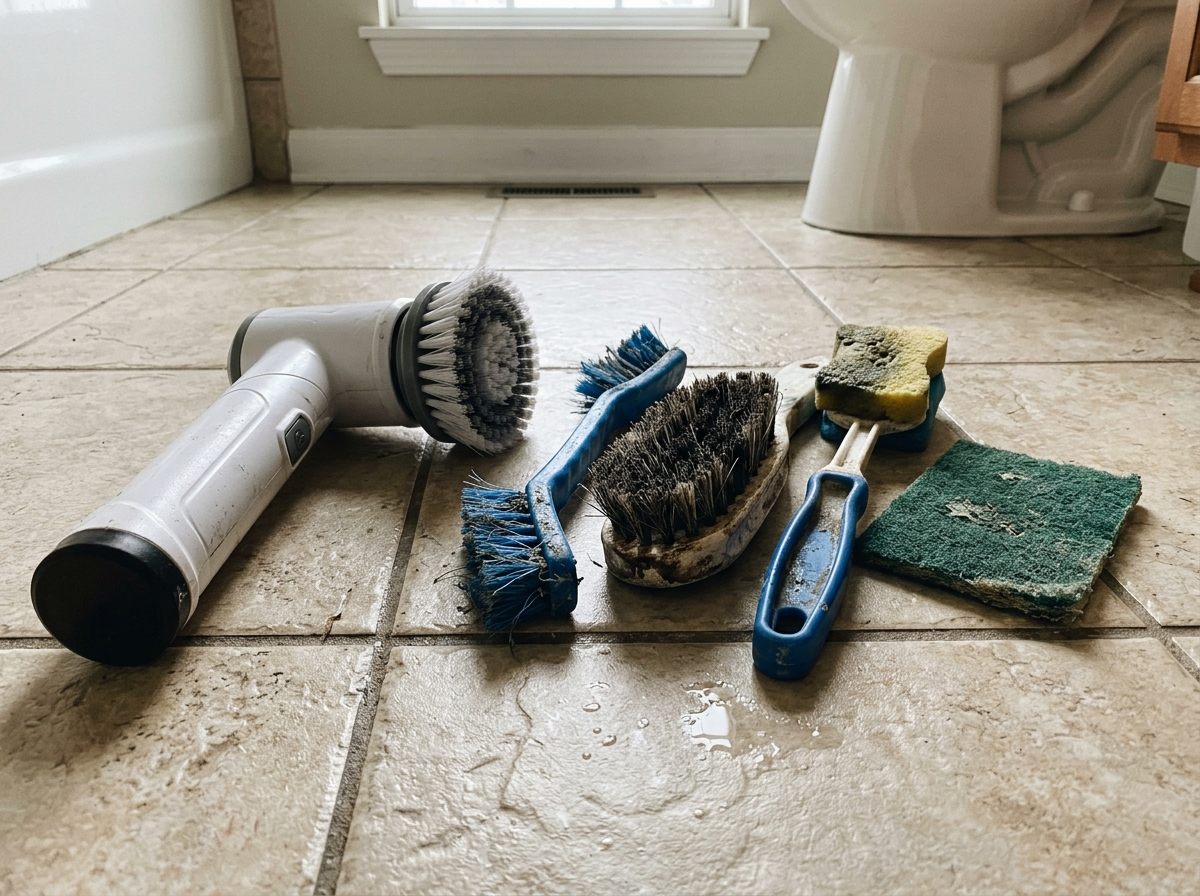
Our cleaning caddy used to look like a yard sale. A stiff-bristle grout brush missing half its handle. A long-handled tub brush that shed bristles every time we used it. A sponge wand that smelled vaguely wrong no matter how often we rinsed it. A handheld scrubbing pad that required us to put our full body weight behind it just to move soap scum half an inch.
We'd been threatening to throw all of it out for months. Then we picked up a handheld cordless electric spin scrubber — one of those rotating-head tools that's been quietly multiplying on store shelves — for about $35. We weren't expecting much. After six weeks and more bathroom sessions than we care to count, it has replaced every single item listed above. Here's the honest version of how that happened.
What we bought and what came in the box
The unit we tested is a handheld cordless spin scrubber with a roughly 10-inch handle and a push-button power switch on the back of the grip. It charges via a magnetic port on the base — no fussing with micro-USB or finding the right angle. The box included four interchangeable brush heads that click on and off in about two seconds:
- A flat round brush — medium-stiff bristles, about 3.5 inches in diameter. General-purpose. This is the one that lives on the scrubber pretty much permanently.
- A corner brush — a small pointed-cone head, softer bristles. Meant for grout lines and tight angles.
- A dome brush — stiffer, shorter bristles in a convex shape. Good for curved surfaces like faucets and drain rings.
- A flat sponge pad — the one head we ended up not loving, more on that in a minute.
The motor runs at a single speed. No variable settings, no burst mode. It spins quickly enough that you can feel the vibration in your wrist, and it maintains that speed under modest pressure. Press it too hard into a surface and the rotation slows noticeably, which is the motor's way of telling you that you're doing more elbow-grease work than it can assist with.
Bathroom tile and grout: where it earned its keep
This is where the case for the spin scrubber becomes almost embarrassingly clear. The corner brush head, pressed into a grout line with a bit of spray cleaner pre-applied, chews through soap scum and mildew buildup at a pace no manual brush can match. We timed it: a two-foot section of floor grout that used to take about four minutes of scrubbing took under 90 seconds with the corner head. Our wrists didn't hurt afterward, which felt genuinely new.
The flat round brush handles the tile faces themselves just as well. The spin motion means you don't have to work in a back-and-forth pattern — you just move the brush slowly across the surface and let the rotation do the work. The results on the white subway tile in one of our bathrooms were noticeably better than what we'd been getting with the tub brush, which was never really sized right for tile work anyway.
Shower glass: a partial win
Let's be clear about what we mean by "partial." The flat round brush on wet shower glass with a drop of dish soap does an excellent job on hard water deposits and that greasy film that accumulates around the bottom third of most shower enclosures. Areas we'd been ignoring for weeks came clean in one pass.
The issue is streaking. After the scrubber loosens everything and you rinse, you're left with a clean surface — but if you let it air dry without a squeegee follow-up, you get a hazy film that shows in the light. This is not unique to the spin scrubber; any cleaning method that uses soap on glass leaves this. But we'd mentally categorized the scrubber as a full standalone and had to adjust. Now we scrub, rinse, and squeegee. Two tools instead of one. Still better than where we started, but worth flagging.
"It does not replace a squeegee on shower glass. Nothing replaces a squeegee on shower glass. We don't know why we keep hoping otherwise."
The tub: the most satisfying use
We tested this on three different tubs — one porcelain, one acrylic, one of those textured non-slip fiberglass floors that are basically grout-line-level difficult to clean. The flat round brush with a standard bathroom cleaner spray did better on all three than our old tub brush had done on any of them.
The porcelain tub, which had some stubborn gray scuff marks near the drain (we have no idea what causes these, but they appear reliably), came cleaner than it had in a year. We tried twice with our old brush without getting them, and the spin scrubber cleared them in one two-minute pass. The acrylic tub required a lighter touch — you don't want to press hard with any abrasive on acrylic — but the rotation at light pressure still outperformed manual scrubbing.
The textured fiberglass floor was the most dramatic improvement. Forty seconds with the corner brush, working in small circles, and that floor looked better than it had since we moved in.
Kitchen sink: a surprise addition
We hadn't planned to use the scrubber in the kitchen. It migrated there when we were cleaning the stainless steel sink after a particularly ambitious cooking weekend and found our sponge just wasn't cutting it on the baked-on residue around the drain.
The dome brush on the faucet base and around the drain assembly was genuinely impressive. The rounded shape of that head conforms to the curves of most faucet necks, and the rotation cleared mineral buildup we'd been chipping at manually for months. We also used the flat round brush on the sink basin itself, and on grout lines along the backsplash tile.
It now lives under the kitchen sink about a third of the time. That wasn't the plan but it made sense.
Battery life and charging: honest numbers
The listing said 60 minutes of run time on a full charge. We've never managed to drain it in a single cleaning session, and our bathroom sessions typically run 15 to 20 minutes. In practice, we charge it roughly once a week, and we've never picked it up to find it dead. That's not a rigorous power test, but it's how most people will actually use it.
Full charge from dead takes about 90 minutes. The magnetic charging connector sits flush and doesn't wobble, which is a minor thing but the kind of minor thing that makes a product feel like it was actually designed with attention. We leave it on the charger between uses. No indicator light tells you it's fully charged — just a red light while charging that disappears when you unplug it, so you have to infer.
Brush head trade-offs: what each one actually does
After six weeks of rotating through all four heads, here's where we've landed:
- Flat round brush: The workhorse. Tile, tub, sink basin, backsplash. Lives on the scrubber 80% of the time. The bristle stiffness is well-calibrated — firm enough to be effective, not so aggressive it scratches standard bathroom surfaces.
- Corner brush: Essential for grout. Once you use it on a tile floor you will not go back to a hand-held grout brush. Also good for the track of a sliding shower door, which collects soap grime in a way that previously defied all intervention.
- Dome brush: Niche but genuinely useful for faucets, showerheads, and drain hardware. We probably use it once every three or four cleaning sessions.
- Flat sponge pad: Our least favorite. It works, but the foam absorbs cleaning solution rather than distributing it, and it's harder to rinse clean afterward. A mildew concern waiting to happen if you don't let it dry completely. We've used it twice and mostly left it in the box.
What it does NOT do well
We want to be direct about the limits here, because the online listings for tools like this tend to wave them away.
Tight interior corners
The corner brush is good for grout lines, but it's a cone spinning on its axis — it doesn't reach the actual 90-degree juncture where a wall meets a tub floor. For that corner line, you still need a small manual brush or a finger. Every bathroom has a couple of these spots, and the spin scrubber cannot get into them.
Flat glass streaking
As mentioned: the scrubber cleans glass well, but it does not leave a streak-free finish on its own. You need a follow-up tool. If you're already using a squeegee as part of your shower routine, this isn't an issue. If you were hoping to eliminate that step, you won't.
Heavy calcium scale
Soft water deposits, soap scum, and surface mineral film all respond well. Thick calcium buildup — the kind you get around faucets in a hard-water area where someone hasn't cleaned in months — will not come off with the scrubber alone. You need a descaling solution applied and left to sit first, then the scrubber finishes the job. The scrubber is not a substitute for chemistry on serious scale.
Delicate surfaces
We used it on our natural stone bathroom floor on medium pressure, and it was fine. But we would not use the stiffer heads on cultured marble or on any surface where we hadn't first tested a hidden corner. The rotation adds friction; combine that with an aggressive cleaner and you can scratch or dull certain finishes. Check your surface first.
Storage and a note on winter use
The scrubber is compact enough to hang on a hook inside a cabinet door or stand upright in a caddy. We've settled on a simple hook mount inside the vanity cabinet, which keeps it accessible without taking up shelf space. The heads store in a small mesh bag that came with the unit — a nice touch that keeps them from rattling around loosely in a drawer.
One thing we noticed when the apartment got cold in winter: the brush felt slightly stiffer on startup for the first few seconds, like the motor was a bit sluggish at lower temperatures. It warmed up within a few rotations and performed normally. Not a real issue, but if you store tools in an unheated garage and wonder why it sounds different on a January morning, that's probably why.
So is it worth $35?
Yes, and we don't say that about many things. We are people who have bought a lot of products that promised to consolidate tasks and delivered on maybe one of them. This one delivered on four. That doesn't mean it's perfect — the corner gaps, the glass follow-up step, the sponge head we ignore — but in terms of raw improvement to our actual cleaning routine, the cordless spin scrubber has made more difference per dollar than almost any other household purchase we can think of.
What it replaced:
- The grout brush — retired, still in the back of the cabinet, will not be used again
- The stiff tub brush — in the trash
- The sponge wand — in the trash, and we don't miss the smell
- The handheld scrubbing pad — down to occasional use on a very specific spot near one faucet
If your cleaning caddy looks anything like ours did — a graveyard of single-purpose tools that all do the same mediocre job — we'd say this is worth picking up and living with for a few weeks. Give every head a real chance, especially the corner brush on your grout. That alone will probably justify the purchase.